
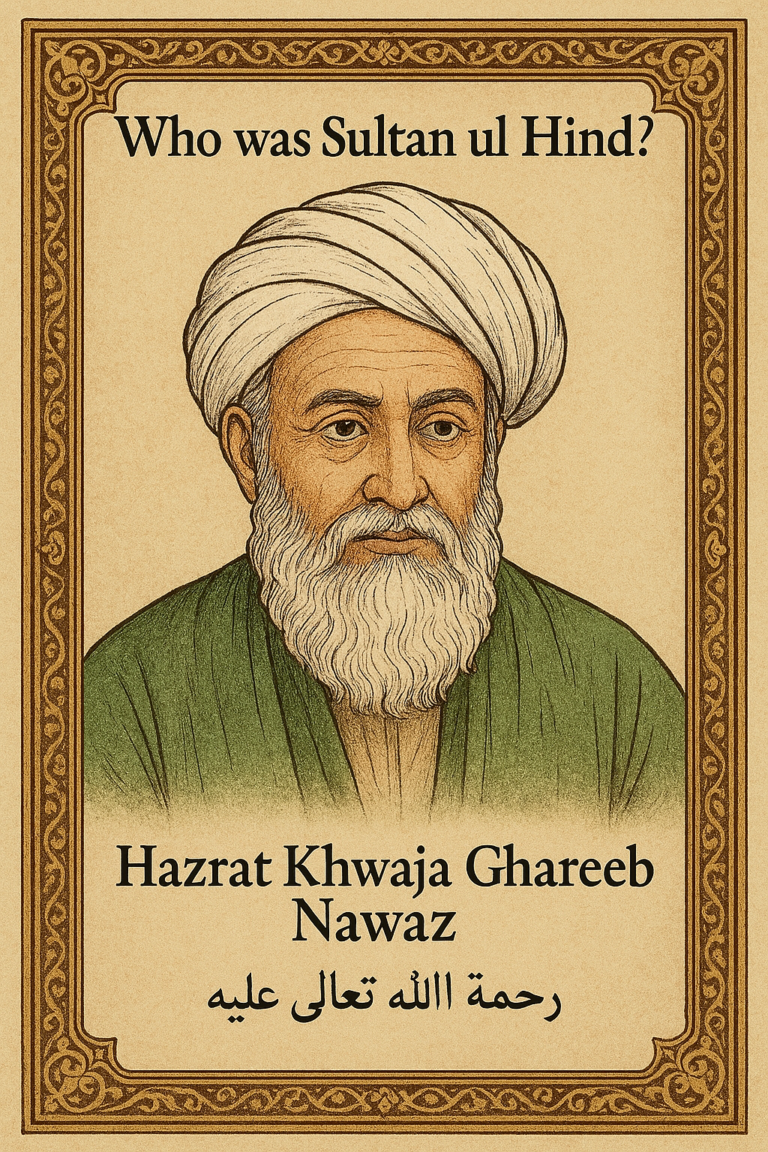
Divine Guidance Through Prophets and Saints
Allah عزوجل, in His infinite mercy and wisdom, chose pure and pious personalities to guide humanity. After the seal of Prophethood with the Beloved Prophet Muhammad ﷺ, the responsibility of spiritual guidance was entrusted to great saints (Awliya-e-Kiraam). These saints became lamps of knowledge and guidance for people lost in darkness, leading them back to Allah through love, wisdom, and character.
The Spiritual Sultan of India
Among these luminous figures stands Hazrat Khwaja Ghareeb Nawaz, also known as Sultan-ul-Hind. He was not only a towering spiritual authority but also a source of mercy for the poor, oppressed, and seekers of truth. His life reflects deep devotion, humility, and service to humanity.
Birth, Lineage, and Noble Family Background
Hazrat Khwaja Ghareeb Nawaz was born in Iran in 1142 CE (537 Hijri), around nine hundred years ago. He was a descendant of the Holy Prophet ﷺ—his paternal lineage connects to Imam Hussain رضي الله عنه, while his maternal lineage traces back to Imam Hasan رضي الله عنه. His father, Hazrat Khwaja Ghiyasud-deen Hasan, and his mother, Hazrat Bibi Mahnur (Umm-ul-Wara), raised him in a pious and honorable household.
Early Life and Spiritual Turning Point
After losing his father at a young age, he inherited a garden and a grinding stone for livelihood. A decisive transformation occurred when the saint Hazrat Ibrahim Qandoozi visited him. Through sincere hospitality and a blessed morsel of food, Khwaja Ghareeb Nawaz’s heart turned completely away from worldly attachment. He sold his possessions, distributed wealth among the poor, and embarked on a lifelong spiritual journey in the love of Allah.
Education and Quest for Sacred Knowledge
Hazrat Khwaja Ghareeb Nawaz memorized the Holy Quran by the age of nine. He traveled to renowned centers of learning such as Samarqand, Bukhara, and Baghdad Sharif. During these journeys, he gained deep Islamic knowledge and spiritual insight, laying the foundation for his future role as a guide to thousands.
Meeting Great Saints and Spiritual Training
One of the most significant moments of his life was meeting Hazrat Shaykh Abdul Qadir Jilani (Ghaus-e-Azam). The Shaykh foretold his future greatness. Later, Khwaja Ghareeb Nawaz pledged spiritual allegiance (Bai‘ah) to his Peer-o-Murshid, Hazrat Khwaja Usman Harooni, under whom he received profound spiritual training and discipline.
Travels Across the Islamic World
His travels took him to Lahore, where he visited the shrine of Hazrat Data Ganj Bakhsh, and later to Makkah Mukarramah and Madinah Munawwarah. In the sacred presence of the Prophet ﷺ, he was bestowed with the title Qutbul Mashaikh—the leader of spiritual masters—and was spiritually commanded to serve Islam in India.
Arrival in Ajmer and Spread of Islam
Upon reaching Ajmer Sharif, Hazrat Khwaja Ghareeb Nawaz transformed the region through love, patience, and exemplary character. Thousands embraced Islam, not through force, but through witnessing his compassion, humility, and unwavering devotion to Allah.
Worship, Piety, and Divine Acceptance
He spent his life in fasting, worship, and remembrance of Allah. He recited the Quran twice daily, remained in a constant state of wudu, and prayed throughout the night. A divine proclamation near the Kaaba confirmed Allah’s pleasure with him and granted salvation for his disciples.
Compassion for Disciples and Power of Intercession
His mercy extended even beyond life. One famous incident narrates how he interceded for a sinful disciple after death, resulting in divine forgiveness. This reflects his elevated spiritual rank and deep concern for his followers.
Teachings, Wisdom, and Spiritual Legacy
Hazrat Khwaja Ghareeb Nawaz emphasized obedience to Allah, loyalty to one’s Murshid, patience in hardship, and the importance of righteous company. He authored several Persian works, including Anis-ul-Arwah, Ganj-ul-Asrar, and Kashf-ul-Asrar, preserving spiritual wisdom for future generations.
Passing Away and Urs of Khwaja Ghareeb Nawaz
He passed away on 6th Rajab 627 Hijri. After his demise, miraculous words appeared on his forehead declaring him a beloved of Allah. His annual Urs in Ajmer Sharif draws hundreds of thousands of devotees from around the world, symbolizing his enduring spiritual presence.
Ajmer Sharif Dargah and Lasting Influence
Today, his luminous shrine remains a center of peace, devotion, and unity, visited by Muslims and non-Muslims alike. His teachings continue through the Chishtiyya order, poetry, qawwalis, and generations of spiritual seekers. For more information contact us.