
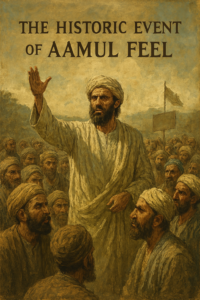
Meaning and Name of Aamul Feel
The Key Aspects Event known as Aamul Feel (also called al-fīl, ʿām, Arabic, عام, الفيل) refers to a defining moment in Islamic history, dated approximately equating 570–571 CE (Date, c.570). This year became a reference point for Arabian and Islamic calendar reckoning years before it was later replaced during the time of Omar.
Political and Religious Background
At that time, Abraha, a Christian ruler and king of Yemen and Ethiopia under Abyssinian control, built a grand church in Sana’a, Sanaa city. His wish was to make people come there for Hajj and divert pilgrimage away from Mecca, Makkah, and Mecca’s Kaaba / Ka‘bah, which he considered a rival. He encouraged tawaf, circumambulate, instead, challenging the spiritual authority of the Kaaba.
Reaction of the Arabs
The Arabs, especially the Quraish / Quraysh, were shocked and angry. One person, in an uncontrollable state, traveled to Sanaa and spread urine and dirt inside the church, intensifying anger and giving Abraha a plight to destroy the Kaaba.
Military Preparation and March
Abraha went forward with an army, having the clear aim to demolish the sacred house. He marched with a large force, famously including war elephants. This group had many big animals, led by the lead elephant named, known as Mahmud, a symbol of military dominance.
The Boundary of Mecca
When the army approached the boundary of Mecca, the elephant refused to move forward, enter, or advance toward the Kaaba, turning elsewhere despite repeated order and effort.
Divine Intervention
Suddenly, flocks of birds, called Ababil, appeared, sent from the sea. They carried small, baked clay pebbles, stones of Sijil / sijjil, holding them in their beak and hands, and struck, attacked the army with powerful punishment.
Destruction of Abraha’s Army
The soldiers tried to run, but the stones broke caps, heads, cutting bodies, causing them to drop to the ground, becoming like eaten straw, leftover, consumed leaves of harvest. Their trick turned into complete devastation, and Abraha was wounded, perished, and died while retreating to Sanaa.
Role of Abdul al-Muttalib
Abdul / Abd al-Muttalib, the grandfather of the Prophet Muhammad (PBUH), was the custodian and leader of Mecca. A strong man with an awesome personality, he showed respect, demanded the return of what he was owner of, prayed, made Dua, and trusted that Allah, the Lord, would save His House.
Spiritual Outcome and Significance
The Kaaba remained safe, unharmed, establishing it as a central spiritual site for the future of Islam. This event occurred in the same year as the birth of the Prophet Muhammad (PBUH), marking a turning point in faith and destiny.
Quranic and Historical Records
The entire account is mentioned, narrated, and preserved in the Qur’an, Surah Al-Fil, Chapter 105, and discussed in tafsir, Shia view, Hadith, al-Kafi, and many other sources, including Islamic history, Events, Siege, Location Wadi Muhassar, Result victory, and divine intervention.
Learning and Reflection
Today, this event continues to shape Cultural depictions, academic References, and modern learning approaches. Through Our Courses, with a simple Monthly fee and a Free trail, students can explore the depth, wisdom, and timeless lessons of The Historic Event of Aamul Feel from both spiritual and historical perspectives.