
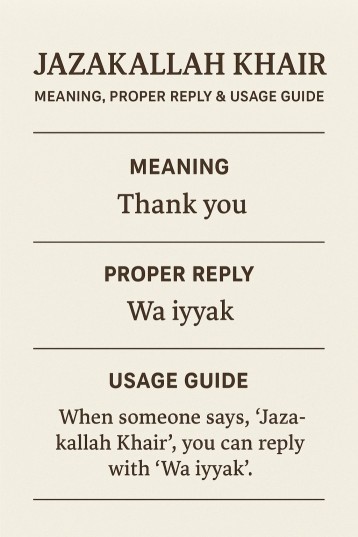
What Does Jazakallah Khair Really Mean?
From my everyday experience in mosques, homes, and even online, the Islamic phrase Jazakallah, JazakAllah, or Jazaak Khair, Khairan, Khayran, khayr (جزاك اللهُ خيراً / ٱللَّٰهُ خَيْرًا) means May Allah, Allaah, God reward you with goodness. These beautiful words carry deep meaning, kindness, and gratitude, and they go far beyond a simple Thank You. Instead of stopping at human appreciation, this polite response shifts recognition to the divine, reminding us that every good deed truly deserves reward from Allah alone.
Why Muslims Prefer This Phrase Over “Thank You”
This phrase is more than social manners; it is a dua, a prayer, and a powerful habit rooted in Islamic manners. I’ve personally noticed how saying it with sincerity builds respect and brings barakah into everyday conversations. Whether someone offers help, a favor, homework support, or a thoughtful gift, using this word acknowledges kindness in a way that feels spiritually complete rather than simple or human.
Grammar Note: Saying It the Right Way
A key grammar note many people miss is that saying Jazakallah alone is incomplete and ambiguous. Without Khair, the meaning is not fully clear. Adding Khair makes the prayer specific, turning it into a clear request for goodness rather than leaving the reward unspecified. This small detail makes a big difference in proper usage.
Proper Replies According to the Sunnah
The proper replies were taught by the Prophet Muhammad ﷺ and are firmly rooted in the Sunnah. Depending on who you are addressing, you may respond with Wa Antum Fa Jazakumullahu Khairan, or use shorter replies like Iyyaka, Iyyaki, Iyyakum, or BarakAllahu Feek, Feeka, Feeki, Feekum to bless a man, woman, or group. Matching the gender and plural form to the recipient—such as Jazaki, Jazakillah, Jazakumallah, or Jazakamullah—shows care and correctness.
Hadith Evidence and Scholarly Practice
Authentic Hadith, narrated by Usamah bin Zaid and recorded in Riyad As-Salihin and At-Tirmidhi (graded Hasan ṣaḥīḥ), explain that praising good is the best response to kindness. This shows that the reply is not just cultural but supported by Islamic teachings, encouraging Muslims to respond thoughtfully rather than mechanically.
Pronunciation and Learning Support
In teaching settings, I often help learners with pronunciation, breaking it down as Jaa-za-ka, Al-laa-hu, Khay-ran, along with Arabic text and Transliteration. This method makes it easier to speak confidently in real-life situations. We follow the same approach in Our Courses, designed with a simple Monthly fee and a Free trail, so students can practice, understand, and use the phrase naturally in daily interactions.