
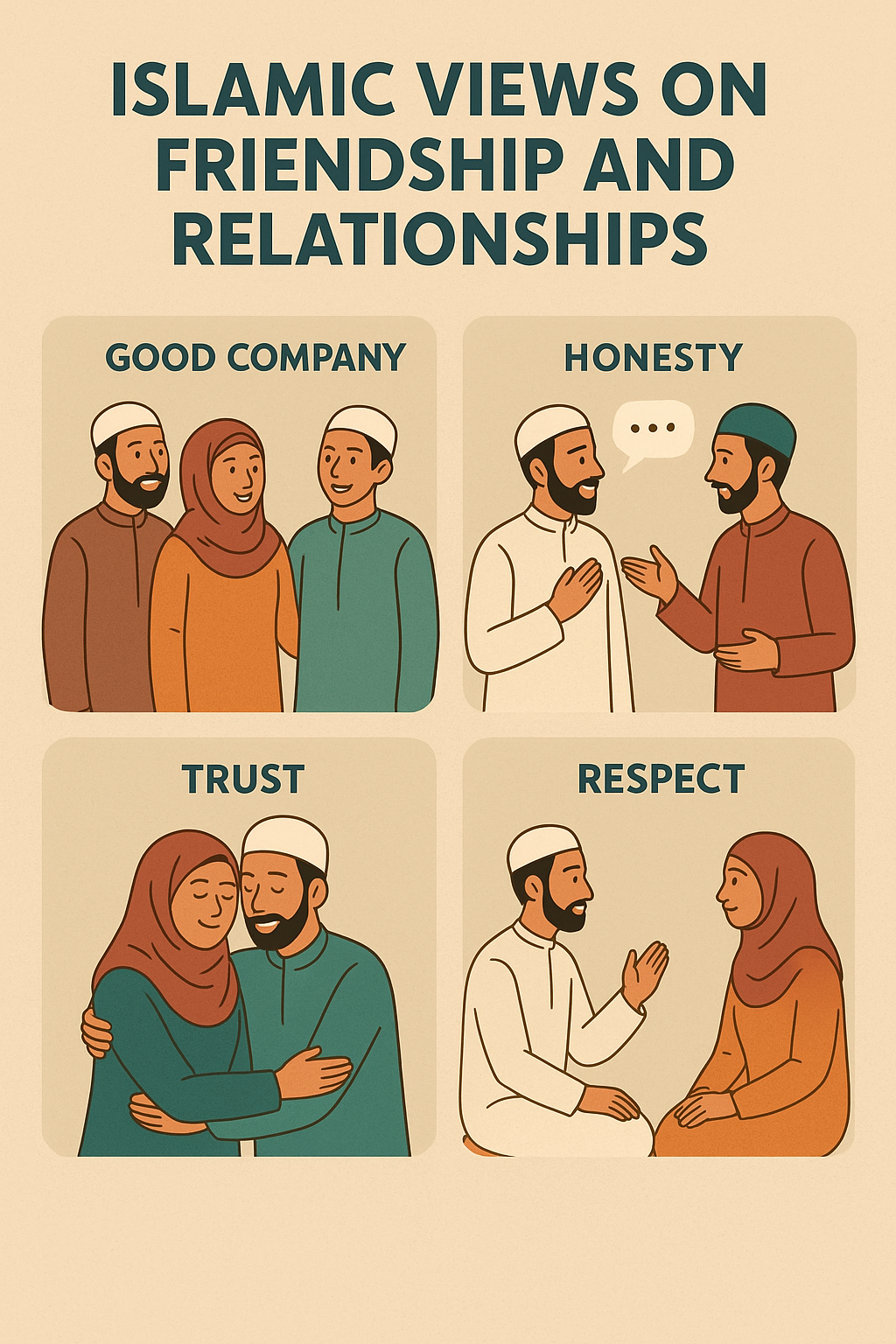
Social Creatures
In Islam, human beings are created as social creatures, designed to live in community and interact with each other. This is rooted in the story of Adam and Hawa, where Allah created Adam and his wife to live on earth together, not in isolation. Their relationship and the subsequent companionship highlight that humanity thrives on relationships. The need for connection and togetherness is not just a social trait but a part of our very belief system, underscoring the importance of coexistence and trust within a society. The Revelation emphasizes that no one should live in solitude or neglect the bonds they share with others, as socializing and engagement contribute to the strength of a believer’s faith.
The Prophet Muhammad (PBUH) taught that true fellowship is built on mutual respect and understanding, where support, empathy, and collaboration are key. He stressed that relationships are not just about fulfilling one’s own needs but also about being there for others, strengthening the unity of the community. Trust and harmony within these relationships are essential for cooperation and sharing, forming the foundation of a thriving society. Just as we depend on others for emotional and physical support, we must also recognize our dependence on Allah for guidance, as only He can help us navigate the complexities of bonding, compassion, and partnership. Through this, we learn that unity in diversity strengthens the network of brothers and sisters, making us better versions of ourselves.
One-Way vs. Two-Way Relationships
In today’s world, it’s easy to feel lonely, especially with the rise of online interactions and the constant use of phones and devices. People often join WhatsApp groups, watch images or pictures, and follow media personalities like Oprah or influencers, but these can sometimes feel like one-way relationships. We might think we have a connection with a celebrity or best friend, but in reality, this is often a parasocial relationship, where there is no real interaction or communication. True relationships are built on giving and receiving, with both sides actively involved, whether it’s in a family bond or with friends.
In Islam, relationships should be two-way, where both people engage and share time, emotions, and support. We are encouraged to develop relationships that are built on mutual respect, understanding, and interaction, rather than just watching or feeling connected through superficial means. True bonds are formed when both sides make the effort to know each other, not just through images or short messages, but by having meaningful conversations. A strong relationship takes effort from both sides and isn’t limited to just one party giving or receiving. The degree of closeness in a relationship grows when there is active engagement, sharing, and continuous support. As we learn from Islam, these qualities form the foundation of healthy relationships, ensuring that they are based on real connection rather than just fleeting interactions.
The Example of Khalil: Friendship in Islam
In Islam, Ibrahim (AS) is known as Khalil of Allah, meaning the closest friend. The title of Khalil is not just given to anyone; it signifies a deep and intimate relationship built on trust, loyalty, and companionship. Like how a friend would confide in you, Ibrahim (AS) trusted Allah with his secrets, doubts, and challenges, creating an unbreakable bond. In everyday life, we often seek close friends with whom we can share personal questions, wins, and difficulties, just as Ibrahim (AS) did. Whether you’re a child or an adult, the best friend is someone who offers unwavering support and is always there, through thick and thin, just as Ibrahim (AS) showed us. The level of trustworthiness and connection in such a friendship is rare, but it sets an example of how true relationships should be in the eyes of Allah.
The Greatest Regret
On the Day of Judgment, some people will feel the greatest regret for not having chosen a khalil (close friend) who could have guided them, as they recite the missed opportunity of earlier times.
يَا وَيْلَتَىٰ لَيْتَنِي لَمْ أَتَّخِذْ فُلَانًا خَلِيلًا
On the Day of Judgment, the greatest regret for some people will be that they chose the wrong friend and went away from the path of Allah, ignoring the close call to choose better friendships in general.
Rekindling Relationships
Over the last five years, many of us have lost touch with friends or family due to work, family, or other reasons. We often get caught up in busy lives and neglect important relationships. However, it’s never too late to rekindle these connections. A simple call, even for 30 minutes, can be the start of something deeper—whether with a close friend, spouse, or even a family member. We should make an effort to choose to rekindle these bonds, like how Prophet Ibrahim (AS) was a khalil to Allah, showing that trust and loyalty form the foundation of meaningful connections. Instead of spending time mindlessly watching Netflix or engaging in two or three small talks, we should make time for real discussion to understand each other beyond surface-level.
The Man with Two Gardens
When I read Surah Al-Kahf, the story of the person with two gardens reminds me of how some people today boast, “Oh, MashaAllah, 5,000 Facebook friends, I’ve reached the limit, I’m at the max.” But like the man who was arrogant about his wealth—saying he had Akthar, malan, wa ‘Azz, nafran—he loses sight of the real importance of quality over quantity. In my own life, I have seen how a Khalil or a closest friend who helps you reconnect with Allah is far more valuable than thousands of online names. The arrogant man was left with nothing because his arrogance blinded him from appreciating what matters most, just like how some forget the blessing of true relationships. Over time, I’ve come to appreciate those rare close friends who stand by you, reminding me that in Islam, it is not about how many “friends” you display on Facebook, but about the sincerity of the relationship that keeps faith alive when you’ve lost everything else.
Spiritual Reminders
I’ve noticed that people who help me grow personally, professionally, and spiritually are the ones I treasure most, because even an average, normal, everyday conversation with a true close friend can become a moment that reminds me of Allah and makes me want to pray or guard my salah more carefully. Unlike chatting endlessly about scores, football, or the latest trends, there is one thing that has real influence: having a good person in your circle who pulls you closer to faith, just like an imam or preacher might do during a khutbah. I’ve learned to keep such friends close, because when they urge you to turn to Allah immediately, the effect is great, and that is the kind of friend who truly makes you better in every way.
Modeling Positive Relationships
When children are watching how we treat our friends, they quickly learn which types of relationships to keep and which to avoid, and in my own life I’ve seen how the Prophet, pbuh, treated people with respect and good character instead of relying on punishment or threats, showing the importance of being a positive model. The greatest indicator of strong friendships is not just what we say in a khutbah, but how our behavior with family, youth, and friendships actually trickles down to them. When we prioritize the right things and give others the attention they truly deserved, we create the kind of connection that Islam teaches through “The Concept of Halal and Haram,” reminding us that our default should always be kindness and dignity in every relationship.
Under the Shade of Allah’s Throne
I often think about how close friends who bring me closer to Allah, swt, will be the very people I hope to stand with on the Day of Judgment, when only those who loved each other for His sake will be granted the shade of His throne. I’ve seen in my own friendship circles how we came together during times of difficulty, challenge, and when we suffered, and that became the reason we could maintain strong bonds. Such groups will testify and bear witness to the love we carried, and in return, they will receive the special help of Allah in both this world and our lives beyond.
أقول قولي هذا وأستغفر الله لي ولكم ولسائر المسلمين فَاسْتَغْفِرُوهُ إِنَّهُ هُوَ الغَفُورُ الرَّحِيمُ
I say what you have heard and I seek forgiveness from Allah for me and you from every sin.
Influences on Youth
When I think about young people and the next generation of Muslims, especially Muslim American children, I remember how much early influences matter—by the age of five, a huge chunk of their life is already spent in school for many hours, listening to a teacher and being shaped by friends. From my own experience, it wasn’t just a parent, but also an older brother, older sister, cousin, or even a friend who helped facilitate the way I understood Islam in my elementary and pre-adolescent years. In every khutbah, I hear reminders that friendships built early expand and grow, and I’ve seen how parents, adults, and family members can either guide or miss the chance to guide—showing that positive influence at the right time is one of the main responsibilities we hold for the next wave of American Muslims.
Wisdom from Ali (ra)
I once heard the advice of Ali, ra, that for the first seven years you should let a child play, then teach them until the age of 14, and after that treat them like a companion, and it struck me how much this connects with how the Prophet, pbuh, raised the sahabah. In my own experience, when dealing with a kid, simply lecturing over every small thing rarely works; instead, real change can happen when friends and companions facilitate growth. A true khalil or close friend becomes an influence who brings you closer to Islam, and that is part of the responsibility we must fulfill in raising the success of the religion—helping each other remain strong, just as the companions once did
Lessons from Sunday School
I still remember being in Sunday school at the masjid, where Quran classes every week felt like the minimum dose of education my parents wanted me to have, even when my mom would leave me there with the reason that I’d make new friends and form relationships that could shape my life. At first, I resisted, sometimes even crying, but later I saw how much I was influenced by those moments—sharing biryani or maqluba when we were invited to gatherings, and learning to feel comfortable in my own skin among other Muslim families. Over time, I noticed how honest bonds were built in those spaces, showing me how deeply our homes and communities can guide us when we grow together.
Struggles of Fitting In
I still smile at a funny situation from seventh grade, when I had just moved schools and my self-esteem was really low, trying to fit in and know what everyone was doing—from getting a new haircut to finding a friend group. As a kid, I once had to choose between two partners for a presentation in health class, and it felt like the best friend decision of my life back then. What was even more interesting is that my previous circle of Muslims from the masjid and weekend activities kept reminding me, “Alhamdulillah, you don’t have to change who you are to belong.” Looking back, I see how those early friend choices can share an influence far bigger than we realize, because they shape not only who we sit with, but how we carry our faith and confidence into the future.
Building Lasting Bonds
When I think about friendship in Islam, I remember one brother I’ve known for over 15 years, and SubhanAllah, even though we first met in middle school and went through high school challenges together, our relationships have lasted because they were built around the masjid. We once took an Arabic class there, and while others weren’t paying attention, we found ourselves supported by each other and by our parents, turning every reminder into motivation. No matter what difficulties happened in life, we kept communication strong, even when we were miles away, because we made the masjid priority and treated our company not just as casual but as something that would carry us through every season of faith.
Nurturing Friendships
It is important for brothers and sisters to facilitate friendships among the youth, and I’ve seen simple ways like study groups or sports at the masjid build lifelong bonds.
Moments After Jummah
I’ve seen how some people treat Jummah like checking the box, just trying to fulfill a requirement before they leave for work or other responsibilities, sometimes even rushing their kids along, but I’ve learned not to judge—because taking just five more minutes or 10 more minutes to give Salam, meet with Muslim friends, and gather at the Masjid can help build a stronger Muslim community. Growing up in a non-Muslim country, I found those short moments on a day off from school became the glue that kept me connected, and even simple announcements reminded me that being part of a Muslim circle is as much about friendship as it is about prayer.
Youth Programs and Timing
I remember a youth program scheduled at 3:45pm, and while it was meant for the kids and youth, it felt like an awkward time because by then schools were just finishing school, and every parent was trying to manage shuttle duties between the masjid and home after Jummah; even waiting just five extra minutes made it harder for parents to balance everything.
Staying Involved
To stay truly involved, I found it helpful to join community activities, read the newsletter, check the website, and even just talk with others after events, because that’s where meaningful friendships often begin.
Going Beyond
I once heard a beautiful story about a Sunday school class that had a waitlist of 10 kids last year, and a parent stepped up to teach because there weren’t enough teachers, showing that sometimes we must go beyond the minimum limit. I’ve seen how one activity at the local masjid can facilitate lasting relationships for kids, giving them close Muslim friends who protect their imaan when they feel challenged or under pressure as Muslims. Even when the drive is inconvenient or online Quran classes seem easier, the environment of a masjid creates a stronger connection for the whole family, and as a result, Allah helps us facilitate true friendships that keep us from feeling down, even with relationships built miles away. Efforts like these not only strengthen relationships but also show how our time and sacrifice raises a generation better represented, and inshaAllah, stronger in faith.
Building Together as a Community
A strong community can facilitate real friendships by doing the simple things that nurture trust and faith.
Lingering After Sunday School
I’ve noticed people at Sunday school sometimes delay leaving so they can pray Dhuhr together at the end, and in those moments they linger, talk, and discuss, which often builds stronger bonds of faith and friendship.
Parenting Program Benefits
In one parenting program at Sunday school, I saw how kids and parents would eat together after food, creating an environment to learn about raising Muslim children, and it reminded me how families grow stronger when they spend time together.
Gathering for Faith and Support
At MAPS, a family night is never just about food or a potluck, but a reminder from imams that such gatherings are an opportunity to get involved, build friendships, and remember that Islam teaches us to support our brothers and sisters. I once attended tonight’s program where we prayed for those in Pakistan, where over 30 million were displaced, asking Allah to alleviate their pain, aid the oppressed, and grant mercy to those who passed away. It made me reflect that when a community comes together, Allah not only protects, fulfills our needs, and helps us, but also allows us to uplift others, raise our ranks in Jannah, and strengthen our bonds, insha’Allah, through shared compassion.