
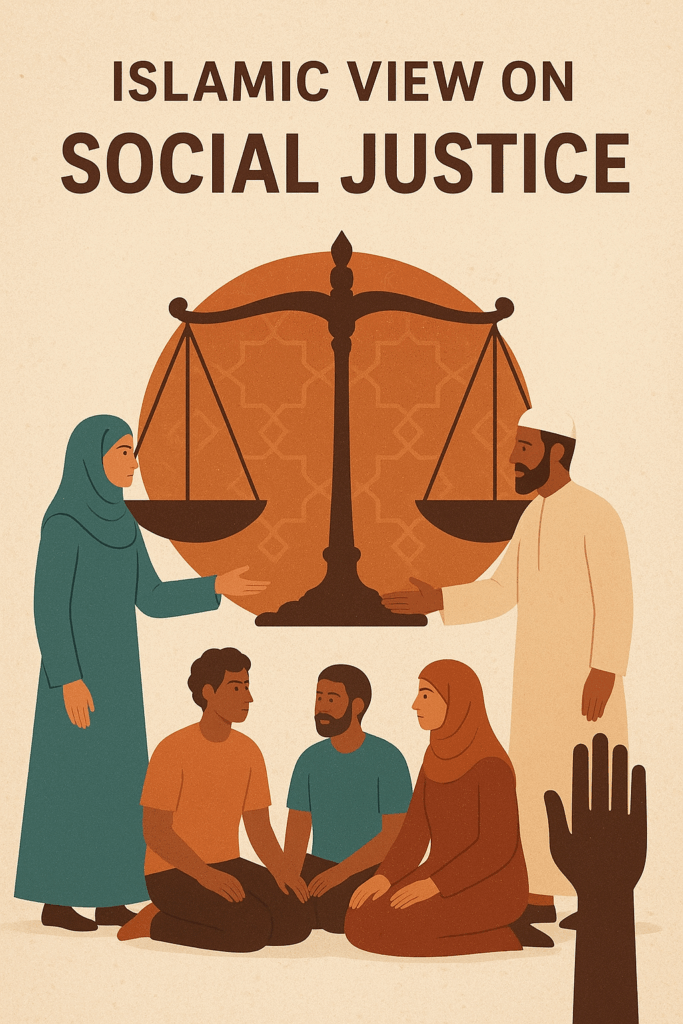
In Islam, justice holds a profound and central place, seen as a reflection of God’s Divine nature. The Qur’an emphasizes the importance of justice by calling on human beings to embody fairness, even to the smallest degree, as it states that one should stand for justice “even if it is against yourself” (Qur’an 4:135). Prophet Muhammad ﷺ is a perfect example of emulating Divine Names like the compassionate and just attributes of God, showing how to live a balanced life rooted in fairness and equality. His actions and sayings promote the idea that Divine Justice is key in ensuring that everyone, from family to neighbors, receives their rightful rights (ḥuqūq). By advocating for the oppressed and assisting the needy, Islam encourages its followers to demonstrate excellent conduct that aligns with Divine justice, creating a relationship of mutual respect and fairness. In every relationship, be it in personal life or with neighbors, animals, or the environment, justice must be maintained as it reflects the harmony of the cosmos and the inherent order set by the Creator.
From the Scales of balance in the Divine Justice system to the concept of piety and belief, Islam teaches that justice is a virtue linked to salvation. The wisdom of scholars like Abū Ḥāmid al-Ghazālī highlights the balance between faith and justice as a means of ensuring the worshipper achieves perfection in their relationship with God. To disregard justice is to commit a grave injustice, one that disrupts the cosmic balance and damages the soul. Islam’s commitment to justice in all aspects of life also calls for impartial arbitration, where bias and interests do not cloud one’s stance, ensuring that every testimony and decision made is rooted in impartiality and the pursuit of justice for all. Through the lens of monotheism and rejecting false deities and shirk, Islam’s view on justice ultimately ensures a just society where human beings, family, and society live in harmony with the Creator.
Understanding Social Justice in Islam
In Islam, social justice is deeply rooted in both a theological sense and a practical application, stretching across all dimensions of human existence. From the vertical dimension of a believer’s relationship with God to the horizontal dimension of interactions between humankind, justice plays a central role. The Qur’anic term for justice, qisṭ, represents fairness and equality, which extend to economic, political, and interpersonal interactions. In every part of life, justice ensures the wellbeing of human beings, from family members to friends and neighbors. Prophet Muhammad ﷺ exemplified how justice can be implemented on a macro-level by advocating for human rights and standing against oppression. His life encourages believers to engage in noble struggles for justice, such as supporting the underprivileged and advocating for a just ruler who leads with wisdom and the virtues of the Divine.
Moreover, Islam teaches that justice is a collective obligation (farḍ kifāyah) and a personal obligation (farḍ ʿayn) to confront injustice in all forms, whether through the hand, tongue, or heart. The Qur’an urges believers to enjoin good and forbid evil, as seen in verses like Qur’an 3:110 and Qur’an 9:71, showing that standing against evil is a faithful striving to be close to God. Justice is also a part of khilāfah, the custodianship of the Earth, where human beings, as viceroys (khalīfa), are entrusted to uphold justice. This cosmic balance not only guides human actions but also secures proximity to God on the Day of Judgment, when the Scales of balance will weigh the deeds of all, determining their eternal fate. In this way, social justice is not just about activism but about living in harmony with the Divine plan, reflecting the Light of the Heavens on Earth
Wealth Distribution and Justice
In Islam, social justice extends to the fairness in the distribution of wealth. The Qur’an emphasizes that believers must take care of the needy through zakāh, a religious obligation where Muslims donate 2.5% of their wealth annually. This alms-tax is an important part of justice, ensuring that wealth is shared fairly in society, providing for the poor and fostering compassion. Wael Hallaq notes that this system promotes social harmony by ensuring resources are not hoarded by the powerful but are distributed to benefit the whole community. Among all “branches” of the law, zakāt is unique in that it has a dualistic character: on the one hand, it is an integral part of religious “ritual,” and, on the other hand, it functions as a substantive legal sphere, constituting itself as a “tax law.” Inasmuch as socially based financial responsibility merges into rituality, rituality merges into the moral accountability for society’s welfare. Like the ubiquitous charitable trust (waqf), zakāt was one of the most important instruments of social justice.
In Islam, justice in wealth is a central concept, where Muslims are encouraged to donate a mandatory amount through zakāh and give additional money through ṣadaqah (charity). Prophet Muhammad ﷺ taught that generosity is essential, not just for Muslims, but for people of all faiths to create a fair and caring community. This act of giving, whether through mandatory zakāh or voluntary charity, is seen as a way to earn God’s favor and strengthen the ties between the son of Adam and his fellow human beings.
O son of Adam, I sought food from you but you failed to feed Me. The man would ask: My Lord, how could I feed You when You are the Lord of the worlds? God replies: Do you not realize that a particular servant of Mine asked you for food but you did not feed him? Didn’t you realize that if you had fed him, you would have found him with Me?
In Islam, charity is essential in addressing systemic injustices and creating real change. ʿUmar ibn al-Khaṭṭāb made sure the state treasury (Bayt al-Māl) provided financial support to those in need, like a mother with an infant, demonstrating the importance of kindness and care. As taught in the hadith, helping others is praiseworthy and a way to rectify inequalities on a comprehensive scale. Through this, Islam encourages addressing hardships and creating a systematic change to promote justice for all, fostering collectively a society where everyone benefits, just as God intends.
Standing with the marginalized
Prophet Muhammad ﷺ gave clear instructions on supporting the weak and helping the oppressed, especially in places like Madinah where Islamic activism grew. His message emphasized advocating for the marginalized and standing as allies to those who are wronged. The Qur’an 4:148 highlights the importance of listening to demands for justice and not publicly mentioning faults or evil when offering supplication. This legacy encourages reconciliation and support for the oppressed, promoting a comprehensive society free from barriers and injustice, as God is All-Hearing and All-Knowing.
The Rights of Orphans
In seventh-century Arabia, orphans had little status and were often vulnerable in a society driven by tribal affiliation and patrilineal descent. Prophet Muhammad ﷺ, who grew up an orphan after losing his father and mother by the age of six, knew firsthand the importance of protection and security for the most vulnerable. The Qur’an and Prophetic traditions strongly emphasize the rights of orphans, making it clear that justice towards orphans is a key component of social justice. In Qur’an 107:1-2, Allah condemns the rejection of faith by those who repel the orphans, warning against the harshness faced by these innocent souls. The teachings urge believers to emulate the Prophet ﷺ by offering not only physical and financial security but also emotional security to prevent the exploitation of orphans in any form.
Living in a tribalistic milieu where the upper echelons controlled resources and influence, the Prophet ﷺ set the archetype for justice. He created a society where the rights of the disenfranchised were upheld, and the most vulnerable were protected. His life serves as an emblematic example of how a just community should treat the marginalized, ensuring that orphans receive the care and support they need for a dignified life.
Slavery and Its Abolition
In the economic context of pre-industrial societies, slavery was often seen as a form of coercive labor that existed in ancient civilizations, including pre-Islamic Arabia, where individuals were treated as property in labor transactions. Islam introduced a critical shift, not just condemning the maltreatment of slaves but also promoting the eradication of slavery through gradual steps, including freeing slaves as part of one’s spiritual journey to please God. Islam’s approach to social injustice encouraged the fair treatment of all individuals, and it recognized that slavery was an oppressive system that needed to be dismantled, ensuring justice and equality for everyone.
What will make you understand the uphill climb? It is the freeing of a slave. Or feeding on a day of severe hunger the close orphan or the needy person lying in the dust. Then he will become one of those with faith, who urge one another to have patience and urge one another to show compassion and mercy. (Qur’an 90:12-17)
In the time of Prophet Muhammad ﷺ, slaves were often mistreated and abused, with many powerful tribes and Makkan elites treating them as property. However, Islam took a strong stance against this injustice, and the Prophet ﷺ actively worked to free slaves, offering a reward in the Afterlife for those who did so. Notable figures like Abū Bakr and ʿUmar ibn al-Khaṭṭāb led by example, with Abū Bakr freeing 63 slaves, and ʿAbd al-Raḥmān ibn ʿAwf freeing thirty-thousand. The Hadith in Ṣaḥīḥ Bukhārī emphasizes the rights of slaves, urging Muslims to treat them with dignity, provide food, clothes, and care, and never to mistreat them. Slave owners were taught to see their servants as brothers, and slavery itself was seen as an abominable act, prohibited by Islam.
The early Muslim community was committed to freeing slaves, exemplified by the story of Bilāl ibn Rabāḥ and ʿĀmir ibn Fuhayrah, who were both freed and brought to prominence by the Prophet ﷺ. Even non-Muslim slaves were not exempt from these rights, as seen when Ḥakīm ibn Ḥizām freed 100 idolater slaves. This exhortation for freedom and justice was a critical part of Islam’s ethical code, which prohibited enslaving free persons. The fight against exploitation and abuse continues today, with modern rulers and leaders, such as the Tunisian ruler Ahmad Bey in 1846, taking steps toward abolition and freedom. In the modern world, this message echoes in the fight against human trafficking, child labor, and forced marriages, as Islam remains committed to the freedom and dignity of all people.
Respecting Persons with Disabilities in Islam
In Islamic society, individuals with physical disabilities or mental disabilities are treated with respect and dignity, following the teachings of Islam. The Prophet Muhammad ﷺ led by example, showing kindness to ʿAbd Allāh ibn Umm Maktūm, a blind man who was honored with the daily calls to prayer, and Bilāl Ibn Rabāḥ, who overcame discrimination and marginalization. These legacies emphasize the importance of respecting and empowering those who are stigmatized or marginalized. In the Qur’an, the 80th chapter stresses compassion and dignity for people with disabilities, calling on believers to offer assistance and care in the spirit of God’s command. This aligns with The Rights of Parents in Islamic Region, where the care and respect for all members of society, including the vulnerable, is a core principle.
Islam also promotes growth and public awareness in addressing disabilities, ensuring that individuals with learning challenges have access to educational opportunities. The ethical framework of Islam teaches that society should provide safe spaces, mental health counseling, and opportunities for everyone to participate in gatherings and contribute to society. By fostering an inclusive environment where all individuals can enjoy equal dignity, Islam helps correct stigmatization and supports the comfort and well-being of those with disabilities, making them feel satisfied in their role within the community.
Equality Across Ethnicities in Islam
Islam emphasizes social justice as a fundamental principle. The Qur’an contains a famous passage that advocates for racial equality, highlighting that all people are equal in the eyes of Allah. This core teaching promotes fairness and respect for all, regardless of their ethnic background.
O Humankind, verily we created you from male and female and made you into nations and tribes so that you may know one another. Indeed, the most honorable of you in the sight of God is the most pious. Verily, God is all-Knowing, all-Aware.
Islam promotes racial equality and challenges the idea of superiority based on ethnic identities. A famous sermon by the Prophet ﷺ during the pilgrimage states that all Muslims are equal, regardless of their skin color or ethnicity. This verse, often universally cited, teaches that human interactions should be guided by virtue and piety, not by external differences. In the sight of God, an individual’s honorable status depends on their character, not their background. Islam encourages harmony among all people, focusing on what truly matters—inner righteousness rather than outward traits..
O People, your Lord is One, and your father (Ādam) is one. Verily, there is no superiority of an Arab over a non-Arab nor a non-Arab over an Arab. There is no superiority of a white over a black nor a black over a white. Only piety causes one to excel.
The story of Bilāl ibn Rabāḥ, an iconic figure in Islam, is a powerful example of racial equality. Born as a slave in Abyssinia, he was freed by Abū Bakr and became one of the Prophet ﷺ’s most loyal companions. His call to prayer from the Holy Ka’ba is a lasting symbol of Islam’s message of unity. Despite facing racist remarks from the Makkan elites, he stood firm, embracing Islam and its principles of monotheism. The Qur’anic verse 49:13 emphasizes that all people, regardless of ethnic backgrounds or colors, are equal in the sight of God, a message that resonated with later movements, like the civil rights movement in the United States, and figures such as Malcolm X. This call for brotherhood and equality continues to inspire Muslims worldwide, reminding us that no one is above another based on race or color.
The Importance of Respect for Other Faiths
Islam emphasizes compassion and kindness to all, regardless of faith or background. The Qur’an teaches that there should be no compulsion or coercion in matters of faith, and that everyone should be free to practice their beliefs. As the Prophet ﷺ showed, people from different religious communities can cooperate for social justice and moral virtue. This teaching is reflected in the ḥilf al-fuḍūl, a historical alliance in Makkah where Muslims, alongside people of other faiths, stood for the oppressed and fought against injustice.
Respecting the convictions and ideological affiliation of others is crucial in a world of diverse faiths and identities. God commands believers to uphold the values of justice, compassion, and piety, irrespective of whether someone belongs to the same religion or not. The story of Caliph ʿUmar ibn al-Khaṭṭāb and the Christian peasant serves as a powerful reminder of how justice should prevail, with God being the ultimate custodian of all. The moral responsibility of each nation is to support, without bias, those who are oppressed and ensure that no one faces retribution due to their class, ethnicity, or religion.
Women’s Rights in Islam: A Revolutionary Change
In seventh-century Arabia, the status of women was often demeaning, with practices like female infanticide and a preference for sons over daughters. The Qur’an brought a revolutionary shift in this treatment, emphasizing that both sons and daughters are gifts from God. Verses like Qur’an 16:58-9 and Qur’an 81:8-9 highlight that the birth of a daughter should not be viewed with sorrow, and the Prophet ﷺ stressed that those who raise daughters with love and care will be rewarded with paradise. This marked a huge change in society, moving away from cultural favoritism to spiritual equality between the sexes.
The Qur’an, particularly in the fourth chapter, grants women economic rights, marital rights, and spiritual equality. It ensured that women could participate in labor, own property, and have equal counterparts in society. Figures like Aisha, the Prophet’s wife, who taught over 300 students, and Samrāʾ bint Nuhayk and Shifāʾ bint ʿAbd Allāh, who served as market advisors and supervisors, prove that women were highly respected in areas such as education, governance, and community leadership. Caliph ʿUmar ibn ʿAbd al-ʿAzīz also recognized the importance of women’s authority, with historical records showing women scholars like ʿAmrah bint ʿAbd al-Raḥmān and Maryam al-ʿIjlīyah, who contributed immensely to fields like astronomy. This shows that the Qur’an not only elevated women’s rights but also celebrated their roles in all aspects of life.
Conclusion
The Islamic faith, with one-quarter of the world’s population, carries a profound tradition of social justice deeply embedded in its spirituality and guidance for humankind. Muslims are seen as custodians of the world, divinely entrusted with a duty to stand for the oppressed and uphold the truth in all matters, regardless of power or influence. Prophet Muhammad ﷺ and his companions set an example of how to serve God by caring for those in need and working toward justice for all. This commitment to social justice is a way to revitalize the true essence of faith in everyday life and is not just about spiritual fulfillment but about making a difference in the world.