
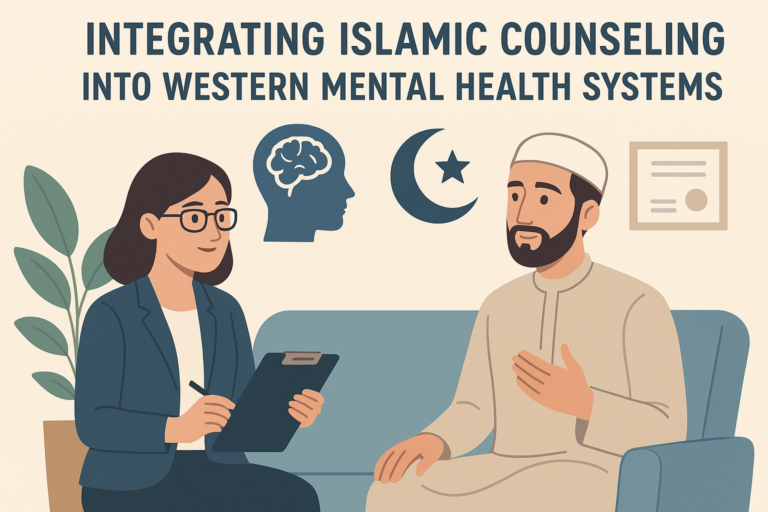
A Faith-Centered Way to Respond to Mental Health Needs
From years of working with individual cases and community sessions, I have learned that mental health is a universal concern that affects individuals, families, and communities across the globe. In countries such as the UK, Europe, North America, and beyond, Western mental health systems have developed advanced practices rooted in psychology and psychiatry. However, many Muslims living in these regions actively seek counseling that aligns with their faith, culture, and spiritual values.
The Need for Faith-Sensitive Mental Health Care
Integrating Islamic Counseling into Western Mental Health Systems plays a unique and powerful role by enriching the therapeutic process and ensuring culturally sensitive care for Muslim clients. By bridging spirituality with evidence-based approaches, counselors can provide holistic support that addresses emotional well-being alongside faith-based needs. This integration helps clients feel seen, understood, and respected within therapeutic spaces.
Foundations of Islamic Counseling
Islamic counseling is rooted in the Qur’an, Sunnah, and centuries of scholarly wisdom. Unlike purely secular models, it combines spiritual guidance with psychological techniques such as cognitive, behavioral, and psychodynamic methods. This holistic care considers the soul, heart, mind, and body as interconnected parts of healing. For many Muslims, faith is not separate from mental health but an essential part of recovery and resilience.
Why Integration Matters for Muslim Communities
Muslim populations continue to grow in Western countries including the UK, France, Germany, Canada, and the United States. Many individuals face challenges related to migration, identity, and cultural adjustment. Integrating Islamic counseling reduces stigma, builds trust between clients and therapists, and encourages help-seeking by framing therapy as part of spiritual and emotional well-being rather than a sign of weakness.
Evidence-Based Frameworks Supporting Integration
Successful integration draws on structured frameworks such as the Bio-Psycho-Social-Spiritual (BPSS) model, which expands standard mental health models by recognizing spirituality as a vital component of well-being. Approaches like Islamic Cognitive Behavioral Therapy (ICBT) adapt CBT principles to align with Islamic worldviews, improving engagement and adherence while remaining evidence-based.
Training, Collaboration, and Cultural Competence
For integration to work, training and education are essential. Mental health professionals benefit from learning Islamic psychology, cultural humility, and religious literacy. Collaboration between psychologists, psychiatrists, Islamic scholars, and community leaders allows faith-based yet evidence-driven models to emerge. These partnerships help bridge theoretical gaps between secular psychology and Islamic tradition.
Online and Community-Based Counseling Models
Digital platforms and online academies have made Islamic counseling accessible worldwide. Muslims in the Middle East, Europe, and remote areas of North America can now access culturally sensitive care through online sessions. Community-based models involving mosques and Islamic centers also create safe spaces that blend professional therapy with Islamic values.
Addressing Inequalities and Structural Barriers
Black and ethnic minority groups, including many Muslims, face inequalities in healthcare access, stigma, and discrimination—particularly within systems like the NHS. Faith-sensitive counseling helps address fears of stereotyping and cultural incongruence, improving access and outcomes for underserved populations while reducing isolation and mistrust.
Challenges and the Path Forward
Despite progress, challenges remain, including misconceptions that religious counseling is unscientific, lack of standardization, and limited awareness among Western practitioners. Moving forward requires collaboration, research, and institutional recognition of faith as a legitimate component of healing. Online academies and training initiatives already play a role in shaping this future.
Learning, Support, and Accessible Opportunities
Through Our Courses, a flexible Monthly fee, and a Free trail, learners can access counseling, education, and Quran-based guidance that supports mental health, faith, and long-term well-being. These initiatives help transform therapy into an inclusive, compassionate, and culturally responsive experience for Muslims worldwide.