
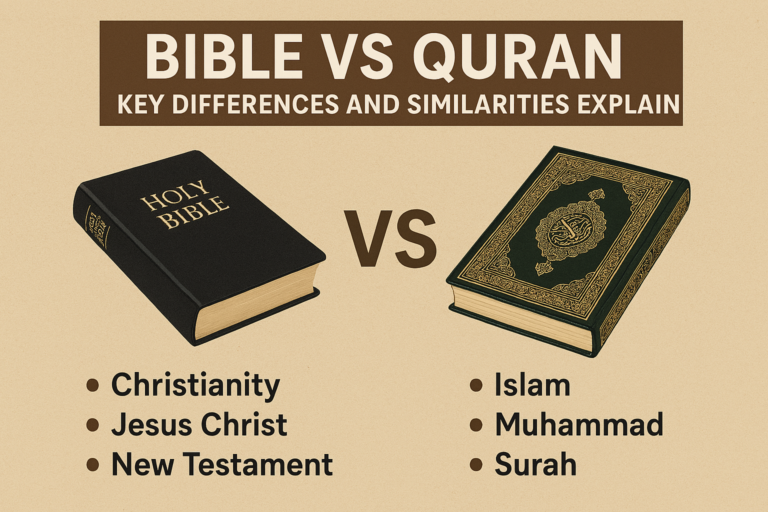
Introduction to the Bible and the Quran
The Bible and the Quran are among the most significant religious texts in human history, revered by billions of people around the world. Each is a holy book and sacred text at the center of Christianity and Islam. Comparing these texts helps explain both the Key Differences and Similarities Explained, while also revealing common themes, narratives, and theological contexts that continue to shape faith and culture today.
Concept of God: Trinity vs Tawhid
One of the most discussed differences between the Bible and the Quran is the understanding of God. In Christianity, the doctrine of the Trinity presents God as Father, Son, and Holy Spirit—three persons sharing one essence. The Quran, however, strictly rejects any association, division, or form, and instead emphasizes absolute oneness, known as Tawhid. Despite this contrast, both traditions affirm Monotheism, the belief in one supreme deity.
Scriptural Evidence for the Oneness of God
Both texts use similar and sometimes identical wordings to express ONENESS. Verses such as Exodus 20:3, Deuteronomy 6:4, Isaiah 45:5, Mark 12:28-29, and Surah Al-Ikhlas chapter 112 (112:1-2) include phrases like Hear, Israel, Say, He, Allah, Eternal Refuge, Absolute, and no other gods before me. These passages show how the Old Testament, New Testament, and Quran converge on the concept of one supreme Lord.
Historical Background and Revelation
From a Historical Background perspective, the Quran, believed by Muslims to be the literal word of Allah, was revealed to Prophet Muhammad and compiled in the 7th century CE in the Arabian Peninsula. The Bible, by contrast, is a complex composition of 66 books, written over several centuries, starting around 12th BCE, in Hebrew, Aramaic, and Greek, reflecting a long and layered religious history.
Jesus in the Bible vs the Quran
The figure of Jesus Christ highlights a major theological difference. The Bible centers on his life, teachings, miracles, crucifixion, resurrection, ascension, and Second Coming. The Quran, however, presents Jesus (Isa) as a Messenger and servant, not divine, not crucified, but raised alive (4:157-159), and destined to return to defeat Dajjal at the End Times.
Shared Moral and Ethical Teachings
Despite doctrinal differences, both texts strongly emphasize Moral Ethical Teachings such as justice, charity, honesty, family values, respect for Parents, modesty in women dressing, and care for the needy. Both speak of Judgment Day, the Afterlife, and accountability for deeds, even an atom’s weight of good or evil, showing shared concern for ethical living and social responsibility.
Which Should You Read: Bible or Quran?
From my experience teaching comparative religion through Our Courses, with a flexible Monthly fee and Free trail, I’ve learned that deciding Which Should Read—the Bible or Quran—always depends on faith, interests, and the level of understanding one seeks. Studying either text, or both together, offers valuable insight into belief, salvation, morality, and spirituality, while encouraging respectful interfaith dialogue.