
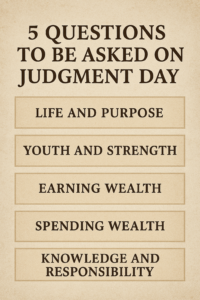
The Reality of Judgment Day in Islam
On Judgment Day, also known as the Day of Resurrection, Islamic tradition in Islam explains through Hadith and Hadees, narrated by Ibn Mas’ud from the Prophet, the Messenger of Allah, Rasulullah, the Beloved Prophet Muhammad, Hazrat Muhammad, that every human being will stand before the Lord, Allah, Allah SWT, God, the Creator, the Supreme Being, Al-Hakam, and the Almighty Lord. As Allah says, and as Allah loves justice, this moment will unfold under complete divine guidance, where every soul becomes fully answerable.
Accountability Before the Supreme Judge
This accountability system is not symbolic. Each person will face questioning on five issues, covering key areas of life—how the entire life was lived on earth, within this worldly life that is short lived. Humans survive briefly on a planet that will be raised again, rewarded, and evaluated according to beliefs, actions, and deeds, including good deeds, bad deeds, and righteous deeds. These questions also include religious duties, adherence to Sharia, and commitment to the straight path, seeking forgiveness, saying Ameen, and preparing for the final verdict that leads either to success, salvation, Jannah, Paradise, and the hereafter, or to failure.
Divine Guidance from the Quran
The Quran, Holy Quran, and Sacred Scripture—including Furqan e Hameed, Surah Al-Humazah, Surah Al-Baqarah, Surah Al-Isra, Surah An-Nisa, Surah Al-Ankabut, and Al-Mumenoon—guide mankind and jinn to worship Me, obey Allah, and obey Messenger. These Ayah teach the purpose of living, the central idea and driving force of life, rooted in Tawheed, the Oneness of God, true belief, pleasing the Rabb, avoiding show off, empty pleasure, luxuries, and false desires, while remaining constant in remembrance.
A Life That Shapes Society
This framework builds a good society that is harmonious and peaceful, protected from fitna, wrongful inclination, and careless free actions. Standing in the court of accountability before Lord involves critical questions that shape eternal hopes, illumination, honor, and the chance to raise rank in the afterlife.
Question One: Life and Purpose
The first of the five issues examines life—how it was spent, the purpose behind actions, whether one pursued veneration, upheld manners and character, chose to be good and do good, avoided destruction, and lived as among the doers of good, following a continuous process of growth and responsibility.
Question Two: Youth and Strength
The second question focuses on youth—how time, strength, energy, maturity, and young age were used amid mistakes, failures, learning, wisdom, conscience, satanic influence, desires, and the pull of the Nafs. It asks whether one turned to repentance, relied on mercy from the Most Merciful, upheld worship, Salah, prayer, faith in the Unseen, respect for parents, kindness, humility, family ties, obedience, and followed the Sunnah and Way of Life.
Question Three: Earning Wealth
The third question addresses wealth—how money was earned, the means of income, whether lawful or unlawful, Halal or Haram, and whether one avoided bribe, Riba, interest, deceiving brothers, breaking covenant, being treacherous, exploiting a slave, laborer, or denying wages. It evaluates discipline, determination, patience, and conduct during test, hunger, fear, loss, and the handling of assets.
Question Four: Spending Wealth
The fourth question asks how wealth was spent—whether through charity, zakat, meeting genuine needs, avoiding misuse, ensuring righteous spending, maintaining Halal expenditure, avoiding Haram expenditure, cinema, haram food, and harmful wedding customs, while helping orphans, widows, poor students, and caring for children. It measures the struggle against stinginess of the soul and pursuit of reward and great reward.
Question Five: Knowledge and Responsibility
The final question concerns knowledge—what was learned, acted upon, and taught, whether one avoided neglect, accepted responsibility that is compulsory, used insight and commandments to choose right over wrong, avoided jealous animosity, manipulate, or deceive, controlled the ego, avoided being boastful or egotistic, and chose to empower, improve lives, and pass on useful information as light for others.
Preparing Through Reflection and Learning
These questions encourage reflection, self-reflection, and reassessing behavior, seeking guidance, remaining constant in prayers, using what was provided, and choosing to spend in way of Allah for true prosperity and protection from punishment. This same structure guides learning initiatives like Our Courses, a balanced Monthly fee, and a Free trail, helping others prepare wisely for the inevitable Day.